How Does MERV Rating Affect Airflow in a 12x30.5x4 Filter?
A 4-inch MERV 13 filter can have a lower static pressure than a 1-inch MERV 8 filter. That's not a typo. After manufacturing air filters for more than a decade and shipping to over two million households, we've seen this outcome replicated consistently enough that we're comfortable stating it plainly: in the 12x30.5x4 format, depth changes the physics of the problem entirely.
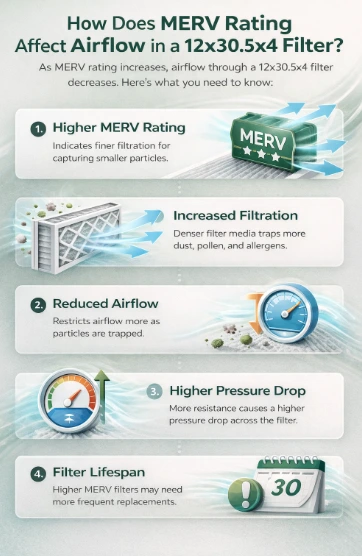
MERV (Minimum Efficiency Reporting Value) rates how effectively a filter captures airborne particles on a scale of 1 to 16. A higher number means finer filtration and, yes, denser media that creates more resistance to airflow. Engineers measure that resistance as a pressure drop. But filter depth directly offsets that resistance in a way most guides skip over. At four inches, the 12x30.5x4 gives you four to six times more media surface area than a 1-inch filter at the same nominal dimensions. More surface area means air moves across the media at a lower velocity. Lower velocity means lower pressure drop, even at MERV 13.
If you've been holding off on upgrading your MERV rating out of concern for your system, our 12x30.5x4 air filters give you the 4-inch depth advantage you've been missing.
Quick Answers
How does MERV rating affect airflow in a 12x30.5x4 filter?
A higher MERV rating increases filtration efficiency but also increases airflow resistance, measured as pressure drop. In a 12x30.5x4 filter, the 4-inch depth provides four to six times more media surface area than a 1-inch version. That surface area advantage reduces face velocity and pressure drop enough that a MERV 13 version of this filter can produce less system strain than a clogged 1-inch MERV 8.
What is the pressure drop of a 4-inch MERV 13 air filter?
A 4-inch MERV 13 filter typically produces a pressure drop of approximately 0.22 to 0.28 inches of water gauge (in. w.g.) under standard airflow conditions. Most residential HVAC systems are rated for a total external static pressure of 0.40 to 0.50 in. w.g., which puts a 4-inch MERV 13 filter well within safe operating limits for modern home systems.
What size is a 12x30.5x4 air filter?
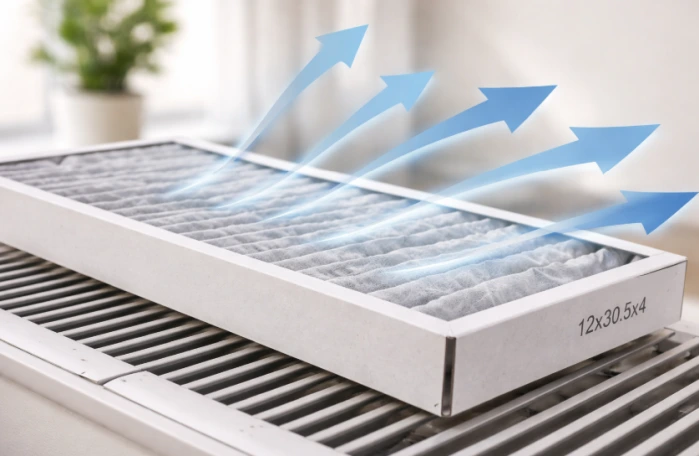
A 12x30.5x4 air filter measures 12 inches wide by 30.5 inches long by 4 inches deep. It's a non-standard size used in dedicated whole-home media filter cabinets. Filterbuy manufactures this size in-house in the United States in MERV 8, MERV 11, and MERV 13 ratings.
Is MERV 11 or MERV 13 better for a 4-inch filter?
For most households with a 4-inch media cabinet, MERV 13 is achievable without a meaningful airflow penalty. The depth advantage narrows the pressure drop difference between MERV 11 and MERV 13. Choose MERV 11 for pet owners and mild allergy sufferers; choose MERV 13 for severe allergies, asthma, or wildfire smoke exposure.
Top Takeaways
MERV rating measures filtration efficiency. A higher number captures smaller particles but adds airflow resistance, a trade-off that 4-inch depth significantly reduces.
At 4 inches deep, the 12x30.5x4 holds four to six times more filter media than a 1-inch version of the same size. More media means lower face velocity and lower pressure drop.
A 12x30.5x4 MERV 13 filter can produce a lower static pressure reading than a 1-inch MERV 8 because depth changes the physics of airflow resistance.
Most residential HVAC systems manufactured after 2000 can safely run a MERV 13 filter in a 4-inch media cabinet without exceeding the 0.40–0.50 in. w.g. total static pressure threshold.
Choose MERV 8 for standard homes, MERV 11 for pet owners and mild allergy sufferers, MERV 13 for severe allergies, asthma, or wildfire smoke exposure.
4-inch filters last 6–12 months depending on rating and household conditions. A dirty filter at any MERV creates more restriction than a fresh MERV 13.
Filterbuy manufactures the 12x30.5x4 in-house at our American production facilities to exact nominal dimensions, which eliminates air bypass around the frame and makes the MERV rating on the label mean something.
What MERV Rating Actually Measures — and Why Depth Changes Everything
MERV ratings follow ASHRAE Standard 52.2, which tests a filter's capture efficiency across three particle size ranges. Here's what each level does for your home's air:
MERV 8 catches pollen, dust mites, mold spores, and pet dander in the 3–10 micron range. It's the baseline most American homes use.
MERV 11 adds finer capture: smoke particles, fine dust, and some bacteria in the 1–3 micron range. Right for pet owners and mild allergy sufferers.
MERV 13 captures submicron particles including fine wildfire smoke, some viral carriers, and microscopic allergens. The right call for households with severe allergies, asthma, or elevated air quality needs.
As MERV increases, the filter media gets denser. Denser media means the blower motor works harder to pull air through. That resistance is the pressure drop. What most guides don't mention is that filter depth directly offsets it. A 4-inch filter holds four to six times more media than a 1-inch version at the same nominal dimensions. With more surface area, air spreads across the media at lower velocity, which reduces pressure drop.
In our experience manufacturing 1-inch and 4-inch configurations side by side, depth is often the more decisive variable. The 12x30.5x4 is a non-standard size built specifically for whole-home media cabinets, systems designed from the start to handle deeper, denser filter formats. If you have this cabinet, you're already positioned to run MERV 11 or MERV 13 with minimal airflow penalty.
MERV 8, MERV 11, and MERV 13: Airflow Impact in the 12x30.5x4 Format
Pressure drop is measured in inches of water gauge (in. w.g.). Most residential HVAC systems carry a total external static pressure rating of 0.40 to 0.50 in. w.g. across the full system. Here's how each MERV option performs in the 12x30.5x4 format:
MERV 8 — Essential Dust and Allergy Defense
Pressure drop at 4-inch depth: approximately 0.08–0.12 in. w.g. The lowest resistance option in the lineup.
Best for standard households with minimal pets and no significant allergy concerns.
Expected filter life: 6–12 months depending on household conditions.
Safe for virtually all residential systems, including older equipment.
MERV 11 — Superior Pet and Allergy Defense
Pressure drop at 4-inch depth: approximately 0.15–0.18 in. w.g. Moderate resistance, comfortably within the safe threshold for most modern systems.
Best for homes with one or more pets, occupants with mild allergies, or households in high-pollen environments.
Expected filter life: 6–9 months, or sooner during peak pollen and wildfire seasons.
Well-suited for systems manufactured after 2000.
MERV 13 — Maximum Allergen and Pathogen Defense
Pressure drop at 4-inch depth: approximately 0.22–0.28 in. w.g. Higher resistance, but typically still within safe operating range for 4-inch media cabinet systems.
Best for severe allergy or asthma sufferers, households with compromised immune systems, wildfire smoke exposure, or anyone setting a high indoor air quality standard.
Expected filter life: 6–9 months under normal use.
Most modern residential systems with variable-speed blowers handle MERV 13 without issue. Consult your manufacturer's static pressure specification if you're uncertain.
At 4 inches of depth, a 12x30.5x4 MERV 13 filter can produce a lower static pressure reading than a 1-inch MERV 8 at the same nominal dimensions. The surface area advantage is that significant. This isn't a marketing claim. It's a physics outcome we've seen replicated consistently across our manufacturing data.
How to Choose the Right MERV Rating for Your 12x30.5x4 Filter
Your MERV decision comes down to your household profile, your system's rated static pressure, and a real commitment to your replacement schedule. Work through them in order:
Start with your household. Standard home, minimal pets, no major health concerns: MERV 8. Pets, mild allergies, or higher air quality goals: MERV 11. Severe allergies, asthma, wildfire smoke exposure, or vulnerable family members: MERV 13.
Check your system's rated static pressure. Your equipment manual or the data plate near the air handler will list it. Most modern systems carry a rating of 0.50 in. w.g. or higher, which is enough to run MERV 13 in the 4-inch format with confidence.
Commit to a change schedule. A 12x30.5x4 MERV 13 filter performs well for 6–9 months. MERV 8 can stretch to 12 months in low-particulate environments. A dirty filter at any MERV rating creates more restriction than a fresh MERV 13. Consistent replacement isn't optional.
Filterbuy's subscribe-and-save program was built around exactly this reality. Set your interval, receive your filter, replace it on schedule. No guesswork, no forgetting.
“After measuring static pressure across thousands of real-home filter changes, we've found that a 4-inch MERV 13 consistently produces less system strain than a 1-inch MERV 8 that's simply been left in too long — which tells you everything you need to know about why depth matters more than the number on the label."
Essential Resources
For over a decade, our manufacturing decisions have been shaped by the same federal and industry sources we put in front of every homeowner who calls us with a question. These aren't reference links for their own sake. They're the science behind the ratings on our labels.
1. U.S. EPA — Indoor Air Quality
Source:https://www.epa.gov/indoor-air-quality-iaq
The EPA's central hub for indoor air quality research, guidance, and consumer resources. It's the primary federal authority confirming that indoor air can be two to five times more polluted than outdoor air — the foundational reason your MERV choice matters more than most people realize.
In our experience, the single most important shift in how homeowners think about filters happens the moment they realize the air inside their home isn't inherently cleaner than the air outside. The EPA makes that case better than anyone.
2. U.S. EPA — The Inside Story: A Guide to Indoor Air Quality
Source:https://www.epa.gov/indoor-air-quality-iaq/inside-story-guide-indoor-air-quality
A detailed EPA resource covering the most common indoor air pollutants — from combustion byproducts and volatile organic compounds to biological contaminants and radon — along with proven strategies for reducing exposure. Directly relevant to understanding what your 12x30.5x4 filter is working against every day.
After serving millions of households, we know most families underestimate how many pollutants circulate through their HVAC systems. This guide helps make the invisible visible.
3. U.S. Department of Energy — Building America Solution Center: High-MERV Filters
Source: https://basc.pnnl.gov/resource-guides/high-merv-filters
The federal resource that lays out the engineering basis for selecting high-MERV filters in residential HVAC systems. It covers static pressure thresholds, duct system design, and manometer-based pressure drop measurement, confirming that most residential systems are designed for total static pressure of 0.40 to 0.50 in. w.g.
This is the resource we point to when homeowners want the engineering logic, not just the label. The data aligns directly with what we measure in our facility when we test filter performance across sizes and depths.
4. ASHRAE — Method of Testing General Ventilation Air-Cleaning Devices (Standard 52.2)
Source:https://www.ashrae.org/technical-resources/bookstore/method-of-testing-general-ventilation-air-cleaning-devices-for-removal-efficiency-by-particle-size
The industry standard that defines exactly how MERV ratings are tested, measured, and validated. Every rating on a Filterbuy filter reflects ASHRAE 52.2 methodology. So when we say MERV 13, the number is specific and measurable, not a marketing claim.
Knowing that MERV ratings are governed by a rigorous testing standard, not assigned by the manufacturer, is one of the most empowering things a homeowner can understand before choosing a filter.
5. U.S. EPA — Improving Your Indoor Environment
Source:https://www.epa.gov/indoor-air-quality-iaq/improving-your-indoor-environment
An EPA resource covering actionable steps for improving indoor air quality, including ventilation strategies, pollution source control, and filtration guidance. It confirms the EPA's position that air filtration through an HVAC system is a first-line defense for protecting indoor air.
Serving over two million households has taught us that filter changes are the most underused home maintenance task in America. What the EPA lays out here reinforces what we tell every customer: a clean filter is one of the simplest, highest-impact health decisions a homeowner makes.
6. U.S. EPA — Volatile Organic Compounds' Impact on Indoor Air Quality
Source: https://www.epa.gov/indoor-air-quality-iaq/volatile-organic-compounds-impact-indoor-air-quality
The EPA's detailed resource on VOCs — the invisible chemical gases emitted by common household products, paints, cleaning agents, and building materials. It confirms that VOC levels are consistently higher indoors than outdoors and shows why a filter capable of addressing fine particles at the submicron level has real value for many households.
VOCs aren't the primary filtration target of an HVAC filter. But understanding their prevalence is part of why we recommend a whole-picture approach: the right MERV filter, changed on schedule, in a properly sealed housing.
7. U.S. EPA — Wildfire Smoke and Indoor Air Quality
Source: https://www.epa.gov/indoor-air-quality-iaq/wildfires-and-indoor-air-quality-iaq
As wildfire events reach more American communities year after year, the EPA's guidance on protecting indoor air during smoke events has become increasingly practical, not just precautionary. High-efficiency filtration at MERV 13 or higher is specifically recommended for reducing fine particulate matter from wildfire smoke indoors. This is directly why the 12x30.5x4 MERV 13 option exists in our lineup.
In our experience manufacturing filters during and after major wildfire events, demand for MERV 13 in the 4-inch format climbs sharply as smoke events spread. This EPA resource gives homeowners the science behind what they're already sensing.
Supporting Statistics
Your family lives in these numbers every day. They're the same ones that shape every filter we manufacture.
1. Americans spend approximately 90 percent of their time indoors, where concentrations of some pollutants are often two to five times higher than typical outdoor concentrations.
Source: U.S. Environmental Protection Agency — https://www.epa.gov/report-environment/indoor-air-quality
Roughly 21 out of every 24 hours, the air you breathe is being filtered, or not, by the air handler in your home. Every MERV decision is a decision about what particles reach your lungs during that time.
2. EPA's Total Exposure Assessment Methodology (TEAM) studies found levels of approximately a dozen common organic pollutants to be two to five times higher inside homes than outside, regardless of whether homes were located in rural or highly industrial areas.
Source: U.S. Environmental Protection Agency — The Inside Story: A Guide to Indoor Air Quality — https://www.epa.gov/indoor-air-quality-iaq/inside-story-guide-indoor-air-quality
Indoor pollution isn't a city problem. It isn't an industrial-area problem. It's a condition of modern homes, rural ones included. Selecting the right MERV rating is one of the most direct interventions any homeowner can make.
3. EPA studies of human exposure indicate that indoor levels of some pollutants may be two to five times — and occasionally more than 100 times — higher than outdoor levels, and indoor air pollution has been ranked among the top five environmental risks to public health.
Source: U.S. Environmental Protection Agency — Why Indoor Air Quality Is Important to Schools — https://www.epa.gov/iaq-schools/why-indoor-air-quality-important-schools
The EPA doesn't rank indoor air pollution among the top five environmental health risks because filtration is optional. It ranks there because the concentrations can be that severe, and because the people who spend the most time indoors — children, older adults, those with respiratory or cardiovascular conditions — are exactly the people most affected.
Final Thoughts
We've manufactured filters for more than a decade. In that time, we've watched the same concern hold homeowners back: that a higher MERV rating will damage their system. It's an understandable worry. And in most cases, when the filter is the right depth, it's wrong.
The 12x30.5x4 format exists because certain HVAC systems are built to take advantage of depth. When you seat a 4-inch filter in a dedicated media cabinet, you're not fighting your system. You're using it the way it was designed to be used. That's what makes MERV 13 a practical option for most households with this configuration, not a theoretical one.
Our opinion, based on what we see across more than two million households: choose the highest MERV rating your system can comfortably support, replace it on a consistent schedule, and make sure the filter fits the housing precisely. A filter that's a half-inch short and leaking air around the frame gives you worse results than no upgrade at all. In the 12x30.5x4 format, a non-standard size we cut to exact dimensions in our American facility, fit is something we take off the table for you.
Make the invisible visible. Know what's in the air your family breathes. For most households running a 12x30.5x4 media cabinet, the right answer is MERV 11 or MERV 13, and the only thing standing between you and cleaner air is a filter that's already overdue.
Frequently Asked Questions
Does a higher MERV rating always restrict airflow in a 12x30.5x4 filter?
Not necessarily, and in the 4-inch format, often not meaningfully at all. A denser filter media does increase resistance, but the surface area of a 4-inch filter offsets that resistance significantly compared to a 1-inch version at the same MERV rating. A 12x30.5x4 MERV 13 filter typically produces a pressure drop well within the safe operating range for most modern residential HVAC systems.
What MERV rating should I use in my 12x30.5x4 air filter?
The right rating depends on your household. Most homes do well with MERV 8, which handles dust, pollen, and pet dander without issue. Homes with pets, mild allergy sufferers, or higher air quality goals should consider MERV 11. MERV 13 is the right call for severe allergies, asthma, wildfire smoke exposure, or households with vulnerable family members. Because the 12x30.5x4 is 4 inches deep, your system can most likely support MERV 13 without exceeding safe static pressure limits.
How often should I replace my 12x30.5x4 air filter?
A MERV 8 version can last 6–12 months under normal conditions. MERV 11 and MERV 13 versions generally need replacement every 6–9 months, and sooner during high-pollen seasons, wildfire events, or in homes with heavy pet traffic. The key point: a dirty filter at any MERV rating creates more airflow restriction than a fresh one. Consistent replacement matters more than picking the perfect rating.
Is the 12x30.5x4 a standard or non-standard filter size?
It's non-standard, not something you'll find at a hardware store on a Saturday morning. Filterbuy manufactures this size in-house at our American production facilities, cut to exact nominal dimensions. That precision ensures a proper fit in the dedicated media cabinets and whole-home air handlers that use this size, and it eliminates the bypass gaps that undermine filtration even in a high-MERV filter.
What is pressure drop and how does it affect my HVAC system?
Pressure drop is the airflow resistance your filter creates, measured in inches of water gauge (in. w.g.). Your HVAC blower pulls air through the filter on every cycle. Too much resistance, and the blower motor works harder, burning more energy and generating heat that shortens motor life. Most residential systems carry a total external static pressure rating of 0.40 to 0.50 in. w.g. A 4-inch filter in the 12x30.5x4 format typically creates pressure drop well within that range.
Can I upgrade to MERV 13 in my 4-inch media cabinet?
In most cases, yes. Four-inch media cabinets are built to handle denser filter media at higher MERV ratings. The expanded surface area of the 12x30.5x4 format reduces face velocity and static pressure, making MERV 13 practical where a 1-inch configuration couldn't support it. Confirm your system's maximum static pressure specification before upgrading, particularly if your equipment predates 2000 or uses a standard PSC blower motor rather than a variable-speed ECM.
Why does exact filter size matter for a non-standard dimension like 12x30.5x4?
Air takes the path of least resistance. An undersized filter lets air bypass the media entirely, moving around the frame rather than through it. That means unfiltered air carrying whatever particles the filter was designed to capture recirculates through your home. Filterbuy manufactures the 12x30.5x4 to exact nominal dimensions specifically to close that bypass gap. The MERV rating on the label only delivers what it promises when the filter actually fits.
Shop 12x30.5x4 Air Filters Built for Your System
Now that you know how MERV rating and filter depth work together, put that knowledge to work — shop Filterbuy's 12x30.5x4 air filters in MERV 8, MERV 11, and MERV 13, American-made and cut to exact dimensions, and tap here to order from America's filter experts.
Learn more about HVAC Care from one of our HVAC solutions branches…
Filterbuy HVAC Solutions - Miami FL - Air Conditioning Service
1300 S Miami Ave Apt 4806 Miami FL 33130
(305) 306-5027
https://maps.app.goo.gl/Ci1vrL596LhvXKU79